El Cielo

Preamble: I realize it has been a while between posts, but sometimes real life (AKA my job on the East Coast) gets in the way. This was the last winery review I needed to post from my first batch of winery visits that took place this past September. I look forward to hitting a few more Baja wineries when I am back in Mexico this coming week! So stay tuned.

El Cielo (The Sky)

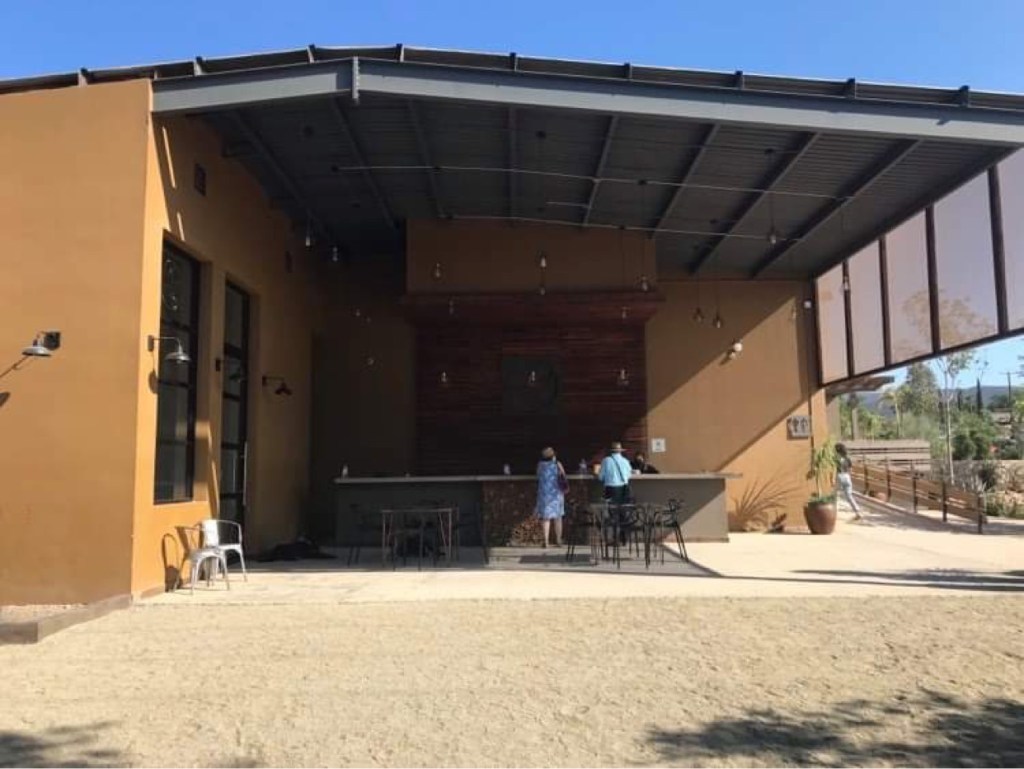
El Cielo was another winery where they want you to book and pay for the tasting online prior to your visit.  In contrast with the other wineries I had visited up to this point, El Cielo was the only one where you still needed to wait in a line with others, including walk-ins, to check-in and receive your receipt to hand to the tasting room staff when you sit down. This line took forever (at least it certainly felt that way to someone raised in NYC!), mainly due to the darn walk-ins who could not seem to be able to make a decision on which of the several tastings to do. Meanwhile, after twiddling our thumbs for about 30 minutes, we finally got our ‘golden ticket’ to hand to the tasting area reception. 

El Cielo is part of a hotel resort and as such, was the most corporate of the wineries I visited on this past trip. It appears to be a very nice resort but definitely does not have the small winery feel that I prefer. 

While waiting for a staff member to come over to our patio table we noticed some tables had cheese platters and decided to order one for ourselves. It was a very nice cheese and meat plate but did not come with utensils of any sort to cut the pieces of cheese nor any plates, only a few cocktail napkins that were sitting out on our table. So basically, we pulled out our alcohol wipes and cleaned our hands then used fingers to break up the cheeses to share and eat. We had ordered the “Astral” Tasting [$1,155.00 Pesos per person to taste 3 wines] with astrological themed labels and reportedly focused on young wines and blends with “fresh and lively flavors”, okay then!

  1. Calypso 2019- Palomino, Chenin Blanc, and Sauvignon Blanc (predominately Palomino):

Fermented in stainless steel. Very dry and steely with medium+ acid, but reasonably well balanced. Perfect with the cheese platter due to the acid level and would make a good aperitif.

2. Rose “Selene” 2019-Syrah and Grenache:

No oak used, skins left on for 4 hours to get the rose color. This was difficult to judge because I detected some TCA taint, I tried talking to our server about this but despite his seemingly good grasp of English, there was no way he would understand what I was trying to say! Despite the taint, I did detect maybe some hint of cherry coming through in the background. Nothing more to say.

3. Eclipse 2018- Cabernet Sauvignon, tempranillo, and merlot:

The winery calls this wine “Eclipse” because the blend changes every year and it “returns” every 12 months after its “journey” in French oak. My favorite of the tasting. Ripe cherry and other red fruits, with vanilla, moderate intensity, medium+ finish. 
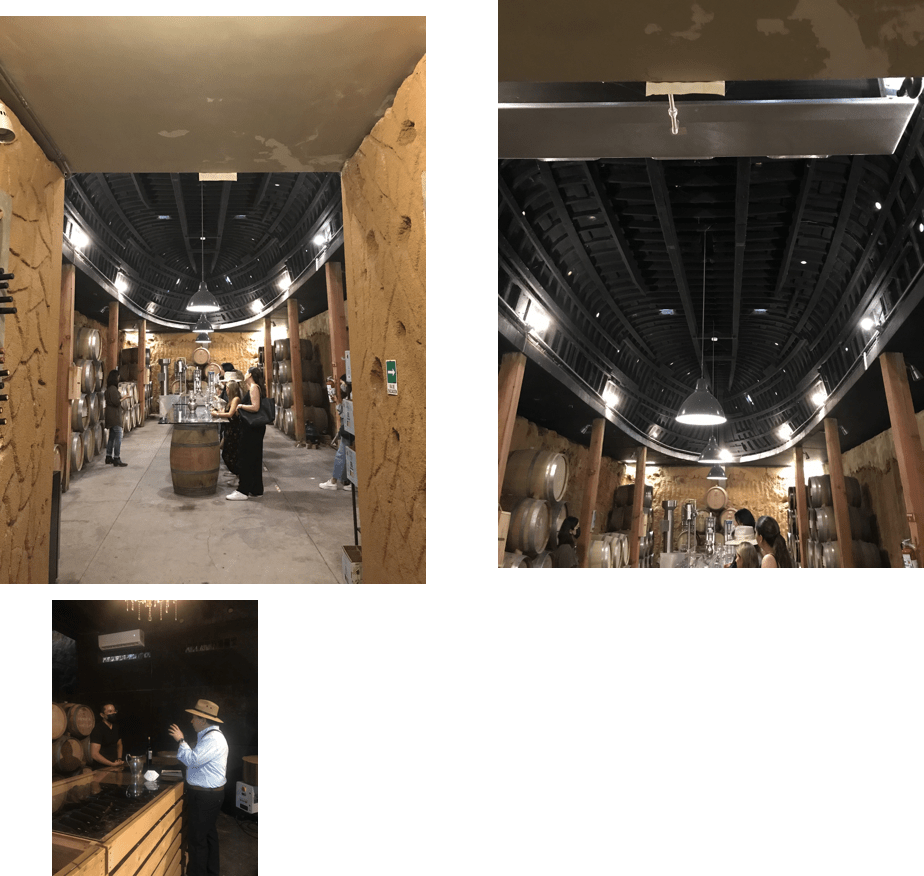
Vena Cava

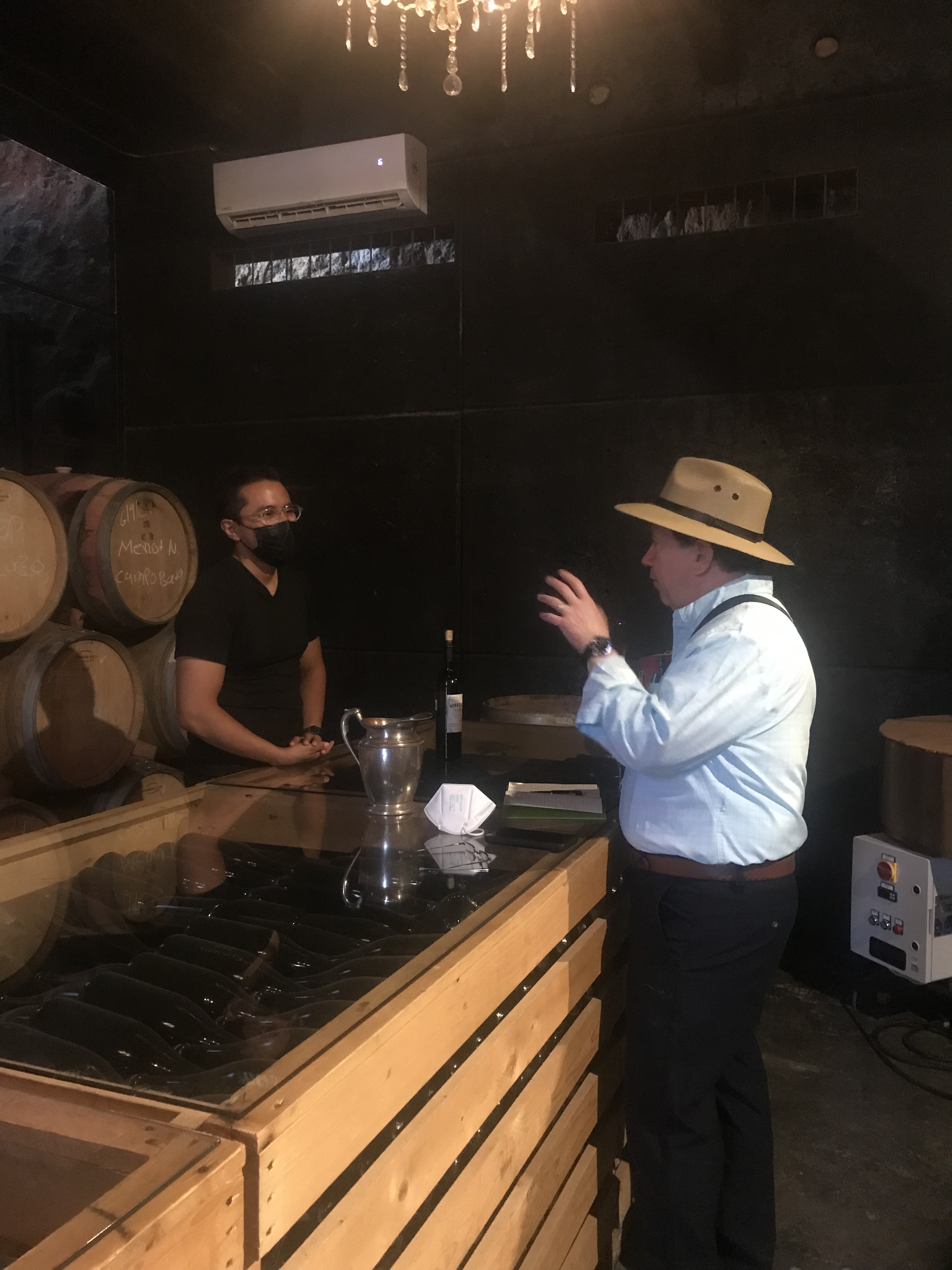
Being a physician, I just could not resist a visit to a winery called Vena Cava! The winery is devoted to recycling, or more specifically upcycling. For example, the roof of the main indoor part of the winery is made from reclaimed fishing boats and other recycled material.

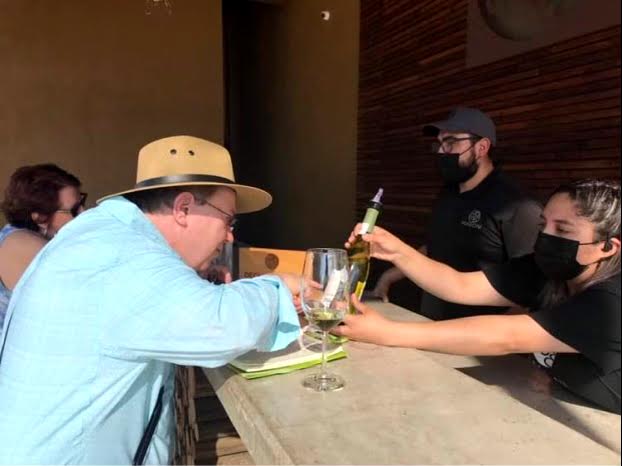
They have a focus on organic wine production which they originally got into in 2005, but not to any appreciable extent until 2014. They currently produce both natural/organic, unfiltered wines as well as more standard traditional wines (i.e. non-cloudy filtered or fined wines). All wines are hand harvested generally between 3-4 am in the morning to insure pristine condition for their journey at the winery. As I noted with several other wineries in the Guadalupe Valley, a reservation is needed in order to do a tasting at Vena Cava. In addition, you need to book  the specific tasting you are interested in along with a credit card number to confirm the reservation. We opted to do the mixed organic and non-organic (standard) wine tasting. 

Our guide Yoel spoke great English, was well trained and very personable. 

  1. Sauvignon Blanc (standard bottling), vintage 2019, tank fermented [$400 pesos]:

Clear, with floral notes and green melon/mango on the nose, bright acid, nice wine overall. 

2. Sauvignon Blanc Natural (organic), vintage 2020 [$550 pesos]:

Turbid, with visible sediment on bottom of bottle, more yellow in color than the standard bottling, Beautiful, fruity with fresh lemon curd in nose, and tart citrus fruits (lemon/lime), high acid on the palate. I was surprised about by how much more I enjoyed this organic “natural” bottling of the SB over the standard bottling. Bought one to take back to the beach house.

3. Grenache Natural, vintage  2019 [$650 pesos]:

Part of the the grapes are aged 13 months in American oak and the other part 13 months in French oak before blending together for bottling. A bit hazy, with fresh red fruits and spice on the nose. Youthful and nice example of a Grenache. 

4. Cabernet Sauvignon, vintage 2018 [$500 pesos]:

Similar to the Grenache noted above, aged 13 months in a mix of French and American Barrels. Red-purple color, ripe red fruits, medium body and texture (Yoel told me 2018 was cold  in the valley so the wines have a lighter body however, I did not find it particular light in body). Overall impression was of great balance, very enjoyable wine.

5. “Big Blend”- Cabernet Sauvignon, Syrah, Petite Sirah, Zinfandel and Grenache, vintage 2018 [$650 pesos]:

This wine was not officially in the tasting I reserved. but Yoel felt I needed to try it and I am happy he brought it over for me to taste. Aged 12-13 months in the usual mix of French and American oak., Medium intensity red color, red and purple fruits on the nose with cinnamon spices and black pepper, very well balanced palate with medium/medium+ acidity and medium- tannins. Really liked this wine, was a toss up between this and the cabernet for a spot in the car ride home, and this one won. 

Additional notes: The winery has a food truck that is parked outside serving small bites. Yoel tells me they also serve a Rose of Grenache and the regular Sauvignon Blanc by the glass, which is handy to know if you turn up without a reservation and are dying for a drink (as my wife did on a previous visit with her daughter and son-in-law)!

I am currently working from my home in Pennsylvania for my “real job” so taking me longer to find time to add more notes, but will try to continue on a regular basis and will be returning to the Baja beach house in November and will hit more wineries that trip. One more winery and some miscellaneous wine bottles tasted at local restaurants, etc. from the last trip to come in the near term…

Salud!

Steve

Just when we thought we had finished tasting at Casa Magoni…

Soon after starting the tasting of the Casa Magoni standard wines, Valeria mentions they have a Magoni “Reserva” tasting they do on the weekends in case I want to come back. I replied that I was up to the task right now, and asked if it were possible to do the reserve tasting after I finish the current tasting set. After Valeria placed a brief phone call to someone else at the winery, a cheese and charcuterie plate appeared, “This is included with the Reserva tasting” is what I heard (so I figured the answer to the phone call was Si ! ). At this point, looking over at our ever-patient driver Jose-Louis, we motioned for him to come over to help us with the beautiful food.

As an aside, it can be very confusing and difficult to find some of the wineries we visited on one’s own so a dependable, local driver who knows the wine region is extremely useful. I can highly recommend Jose-Louis, he is a good English speaker, very friendly, very reasonably priced, and willing to take you anywhere you like, even in the face of last-minute itinerary changes😊 He can be contacted on Facebook at Baja Personal Transportation.

Wine Notes _Part II, Group B

1. Reserva Sauvignon Blanc- Vintage 2017, clone 22 (an American clone) [$490 pesos]:

Fifteen months in American new oak barrels with “special toast” (Juan said this was a medium toast) and 12 months sur lie in same fermentation barrels. Earth on the nose (probably from the sur lie), good acid and fruit, definitely had a sense of place/location on the palate, would not be confused with a New Zealand or Napa Valley SB. Not my favorite of the tasting but worth trying.

2. Tempranillo (clone 770) – 55%, Graciano (clone 01.1)-32% and Granacha (clone 05.1)- 13%, Vintage 2016 [$650 pesos]

Fifteen to 18 months in new American oak barrels. To me the nose indicated the wine was slightly oxidized, Juan told me it had been open 2 days since they mark the dates on the bottle. My notes were sparse on this one, probably due to the oxidation, which I generally have a hard time tasting through but thought it was a light wine with similar weight to a Dolcetto. I did not feel like asking him to open a fresh bottle for me at the time, so will need to retaste next visit.

3. Cabernet Sauvignon (clone 337) -64%, Merlot (clone 348)-11%, Malbec (clone 180)-7%, remainder of percentage grapes included Petite Verdot (clone 001) and Carmenere (clone VCR 702)-Vintage 2016 [$750 pesos]

Eighteen months in American oak. Wow, very Bordeaux like, big, full-bodied, great fruit, texture, tannin and acid. My favorite of the tasting, ended up buying 2 bottles to take back to our Baja home. (Yeah, so I liked it a bit).

4. Nebbiolo (clone 34) 100%, Vintage 2016 [$890 pesos]

Eighteen to 20 months in new American oak, another big wine, oaky and floral, good fruit, probably needs some time yet, even though the wine already has 5 years of bottle age. I preferred their non-reserve bottling reviewed on my previous post.

5. Syrah (clone 877)-50%, Mourvedre (clone 249)-11%, Petite Syrah (clone 05.1)-30%, and Grenache (clone 03.1)-9% [$690 pesos]

A few minutes prior to this pour when I was telling Juan how much I liked the Cabernet, he told me that I should wait, his favorite was the Syrah. Off the bat he was correct about this being a very good wine, but it only picked up a silver medal to my palate.

Spent 18 months in American oak, each of the varietals vinified separately then blended. Beautiful sweet fruit, both on the nose and palate. Another big wine with aging potential and another purchase for home “use”.

A final, more general note: None of the wineries visited seemed to have spittoons out to dump your wine if you are trying to pace yourself, so you need to do one of two things-either 1. ask for a dump bucket or 2. have an eager assistant “taster” who is willing to finish whatever wine you have left in the glass before going on to the next taste (I ended up doing a mixture of each method during my winery visits).

And for now we bid adios to the first of our Baja winery reviews, stay tuned for additional winery reviews as well as related topics coming to this blog soon….

Wine Blog Tasting Notes Primer Capitulo

…and so we begin.

A 10:30 a.m. scheduled pick up from our driver Jose-Louis however, somehow signals got crossed and he thinks he is picking us up mañana (literally). Okay, being a very conscientious person, he somehow scrambles and picks up us about 11:15 a.m. Finally on the way to the first wineries with an eclectic mix of music he had prepared consisting of songs from Frank Sinatra, Janis Joplin, Pink Floyd, Creedence Clearwater Revival and a few other gems, perfect for our generation!

I am going to start my notes with my favorite (for various reasons) winery of this first group visited, Casa Magoni.

Casa Magoni is family owned and currently run by enologist Camillo Magoni. The Magoni family began growing grapes in the 1900s when Camillo’s father inherited a vineyard from his father in Morbegno, Northern Italy. Camillo came to Mexico from Italy at the age of 20 and served as honorary consulate for Italy in Tijuana for 17 years. He received experience in making wines in Mexico as a winemaker at another winery originally founded by an Italian, L.A. Cetto (Don Angelo Cetto), and later by working at Monte Xanic. About 15 years ago, Camillo and his family began making wine from their own grapes in the Guadalupe Valley. The wine made was not originally sold to the public but rather given as gifts to his Italian family and friends when he would visit Italy. Some of these Mexican wines were even entered in wine competitions in Italy. In 2013 the family made the decision to offer their wines to the public and as such, the present winery was born*.  

Winery visit: When we arrived, we were directed to the outside, covered, patio tasting room where Valeria was on duty, she was concerned that her English may not be good enough (she was doing fine BTW) so Juan joined to help.

*Information on the history of the winery was obtained from interviews with the tasting room staff as well as the winery website.

Wine Notes _Part I, Group A

Group A “Mixta”(mixed) tasting of the standard level wines called the Casa Magoni classic line (3 whites and 3 reds, normally includes 2 whites and a rose but the  rose was sold out so a sauvignon blanc was substituted for the rose in the white group)

1. “Manaz”- Vionier 80% and Fiano 20%, vintage 2020 [$220 pesos]:

Fermented in steel, bright straw color with very nice fruity nose consisting of citrus and floral notes with some vanilla tones (we did not discuss if they do malolactic fermentation). We purchased a bottle and noted later it was very food friendly as well.

2. Chardonnay (80%) and Vermentino (20%) [$220 pesos]:

20% of the chardonnay spends 3 months in oak before blending, brilliant color, green apple on the nose, good acid balance, medium body with a long fruit and acid finish. Also liked it enough to purchase a bottle.

3. Sauvignon Blanc (100%) vintage 2020 [$230 pesos]:

Light yellow color, very floral with good fruit and fresh finish. Good, but not special to me and a little atypical on the palate.

4. Sangiovese (40%) and Cabernet (60%) vintage 2020 [$220 pesos]:

Aged in oak, bright red color, beautiful smooth and balanced fruit, with bright cherry and vanilla, a soft palate but with acid on the finish. With airing the bright, soft cherry tones became more like a tart cherry with more acid/tartness showing through. Very enjoyable! Consistent notes the next night with dinner from a freshly opened bottle we had purchased.

5. Origen 43 (named for the 43rd parallel “where the wine is from”) [$270 pesos]:

This is a Super Tuscan blend of Sangiovese, Aglianico, Canaiolo, Montepulciano, with a small amount of Cabernet Sauvignon aged 12 months in used (2-year-old I believe) American oak. Very fresh, big fruit on the nose, full of fruit in the mouth, but only medium in body, Juan said it is a good pizza wine and I agreed.

6. Merlot (60%) and Malbec (40%) 2019 [$300 pesos]:

Spent 15 months in 2-year-old American oak, bright fruit, predominantly purple plums to me, very bright fruit but with firm tannins, I kept picturing a grilled steak in my head while tasting it.

7. Nebbiolo (100%) 2018 [Bonus wine not generally included in the mixed tasting- $370 pesos]:

Aged 15-18 months in 2-year-old American oak, Chocolate and smoke on the nose with bright red fruits. Tannins, full bodied, another steak wine and another one I purchased for home.

There will be a part two to this tasting as I ended up doing their Reserve Tasting (Magoni Reserva Line) as well, so stay tuned in the next few days.

Introductory Post

I first became passionate about wine in 1981, when I moved to a small rent-controlled apartment on the Upper West Side of Manhattan to attend college. I had just become of drinking age and would wander aimlessly around wine stores unsure of what to buy. One day a classmate of mine told me his father did insurance evaluations of private wine cellars, and he would provide me with a list of inexpensive “real” wines to try. With list in hand, I bought my first case of wine, and noticed an application to join a wine society called “Les Amis du Vin” (The Friends of Wine). This group no longer exists in the same form, although individual chapters apparently remain. From there, I started attending formal tastings and ended up becoming entrenched in what was then a small wine subculture in NYC. I took notes at every tasting, soaked off wine bottle labels, and wrote notes in my wine journal. I also had the good fortune to be at the right place at the right time, and was asked to substitute for one of the judges at the Society’s annual international wine competition. This involved tasting 80-90+ wines per day for 2-3 days, awarding medals, and overall falling in love with the whole wine culture. I must have done ok because I was asked back to help judge the next year’s competition as well.

Over the years I moved frequently to various states in the US, and also spent five years in the UK with my day job. My wine habit increased in conjunction with my disposable income. I even worked in a couple of wine stores in my off hours recommending wine to customers. In return I received either bottles of wine to assess which the store was interested in potentially bringing in for sale, or literally punching a timeclock for an hourly rate of wine credit. (1989-1993 with Gary Fisch / 1993-1996 under David Schildknecht).

During the following years, I ran local community blinded wine tastings, and hosted many wine parties, all with the aim to impart education, and transfer my enthusiasm for this wonderful juice.

Fast forward to the present, with my lovely wife Ginni, and as a new owner of a vacation home on the beach in the Punta Banda, Baja Norte area, very close to Valle de Guadalupe, I decided to start a Wine Blog. This is a region I never took seriously before I started to come down to the area on a regular basis. As such, while searching which wineries to visit, and which wines to try, I found that it was hard to find a reliable central place on-line to guide me. Now with the encouragement of my wife, this Baja Wine Geek wine blog is born.

My aim is to provide visitors to the region an honest wine geek opinion on the wineries I visit, some of the friendly staff in the tasting rooms, and some notes on the wines I taste at each visit. I receive no compensation for this work, only the pleasure of continuing my passion and hobby to stretch through the days once I retire from my day job. Though this blog, I hope to impart to you my enthusiasm for a wonderful, blossoming wine region that may be less familiar than other more well known wine regions of the world. Salud, Steve

#bajawines #winesofmexico #valledeguadalupe #puntabanda #ensenada #bajawineries #bajawinegeek.wine #bajawinegeek.com